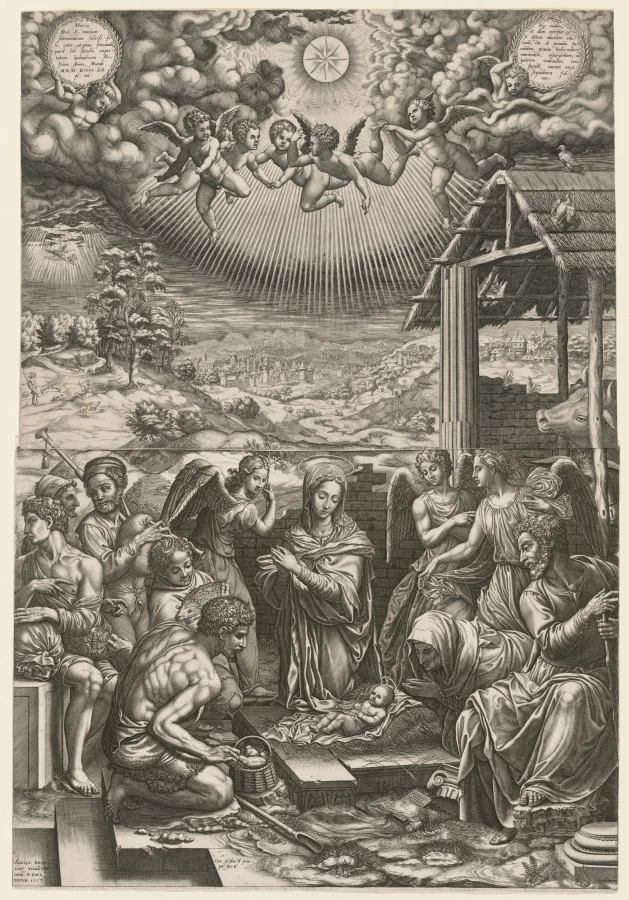
The Nativity
Details
- Author / creator
- Giorgio Ghisi (Italian, 1520–1582)
- Object type
- Date or period
- 1553
- Dimensions summary
- Overall: 67.5 × 45.6 cm; Part 1: 32.9 × 45 cm; Part 2: 34 × 45.6 cm
- Place of origin
- Italy
- Acquisition method
- Purchase
- Credit line
- Purchased with the Hartley Bequest Fund, 1986
- Paper / support
- Laid paper
- State and impression
- ii/ii (top plate) ; iv/iv (bottom plate)
- Catalogue raisonné
- Lewis&Boorsch 14
About this object
The inscriptions praise Mary, the mother of Jesus Christ, emphasizing the great joys and inevitable sorrows that she is to endure in witnessing her son's life and death. After spending about five years in Rome, Ghisi left Italy around 1550 for Antwerp, the major commercial center in the Netherlands. There he worked with Hieronymus Cock (about 1510–1570), founder of the largest and best-known print publishing establishment in northern Europe, called The Four Winds. This print reproduces a painting of similar size by the artist Agnolo Bronzino (1513–1572), painted in the late 1530s for Filippo d'Averardo Salviati of Florence. Making a print based on a work belonging to a private individual was an unusual practice during the 16th century.
Materials and technique
Engraving
Signature and marks
upper left, in plate: Maria / Heli .F. ominum / foeminarum feliciß . so= / la inter virgines foecunda, / parit tot sæculis expec= / tatum Saluatorem Me= / ßiam. Anno, Mundi. / MMM.DCCC.LX. / pl. mi. ; upper right, in plate: Hec eadem, / ut illum mirifice ex / se natum alacriter edu= / cauit, ita et grandia fa= / cientem, gravia tolerantem, / morientum, resurgentem, ad /patrem redeuntem con= / spexit, carum mox / sequutura fili= / um. ; lower left, in plate: ANGILO BRON= / SINI FIORETINO[line over 'E'] / INVE[line over 'E'].H.COCK / EXCVD.1554 ; lower center, in plate: Cum gratia et privi. / per. An.6. ; lower right, in plate: GEORGIVS / GHISIVS / MNTVANVS / .F.M.D.LIII. ; VERSO, top sheet, lower right, in graphite: DO ; bottom sheet, lower left, in graphite: io ; lower left, in red chalk: 3 II/II