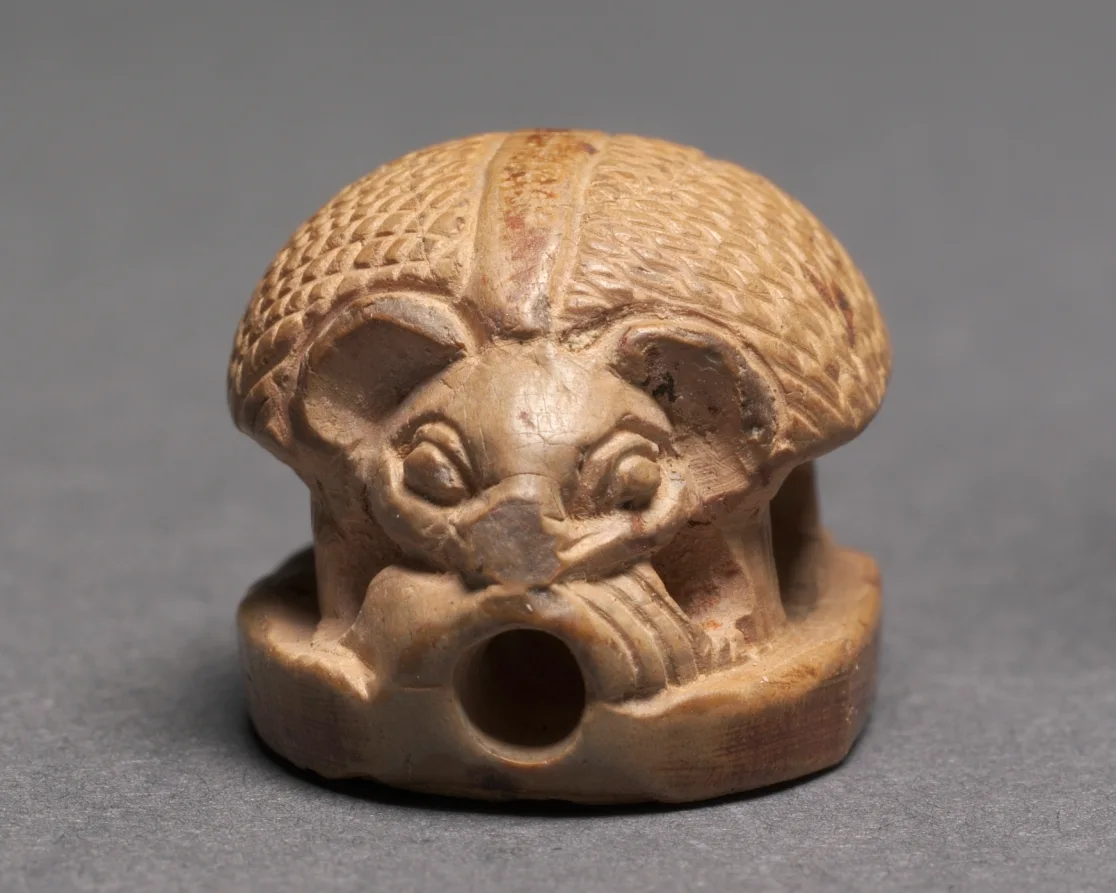
Hedgehog
Details
- Author / creator
- Egypt, New Kingdom (1540–1069 BCE), Dynasty 18, reign of Amenhotep III (1390–1352 BCE)
- Object type
- Archaeology
- Date or period
- c. 1391–1353 BCE
- Dimensions summary
- Overall: 1.7 × 1.8 cm
- Site or findspot
- Hierakonpolis, Egypt
- Cultural period
- Ancient
- Place of origin
- Egypt
- Acquisition method
- Purchase
- Credit line
- Purchased with the Ashcombe City Council acquisitions budget, 1975
About this object
This hedgehog (Paraechinus aethiopicus) stands in the round on an oval base, with openwork defining the legs. The carving is delicate and spirited. The face features large, round eyes; widely spaced, short ears; bulging cheeks; and a protruding snout. A tiny tail hangs at the rear. Crosshatching on the back represents the animal's spines. The design on the base begins at the head with a winged sun disk with pendant uraei. Below is a cluster of hieroglyphic signs, including an ankh-sign, a falcon with a sun disk, a hoe, and a maat-feather. A neb-sign fills the balance below.
The significance of the hedgehog has multiple theories. As a hibernating animal, it may have associated with the powers of self-renewal and resurrection. Another lies in the animal's defensive strategy of inflating itself into a ball and projecting its spines, a posture of obvious apotropaic significance. Lastly, Egyptian folklore maintained that hedgehog amulets provided protection against snake bites, a belief grounded in the animal's natural resistance to poison.
Materials and technique
Steatite, originally glazed