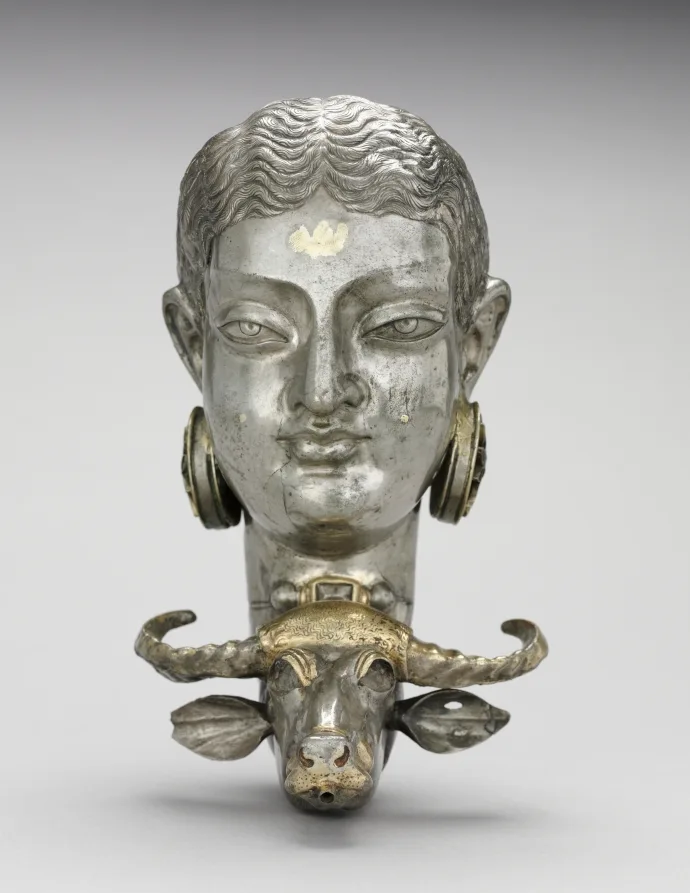
Woman and Water Buffalo Rhyton
Details
- Author / creator
- Sasanian, Iran, 600s or Turk Shahi dynasty, Kabul, Afghanistan, 500s
- Object type
- Archaeology
- Date or period
- 500–700
- Dimensions summary
- Overall: 19.1 cm
- Site or findspot
- Iran (findspot unrecorded)
- Cultural period
- Ancient
- Place of origin
- Sasanian
- Acquisition method
- Purchase
- Credit line
- Purchased with the Hartley Bequest Fund, 1964
About this object
Recalling both Greek and Iranian traditions of head vases and rhyta (drinking horns), this unusual silver vessel combines the heads of a woman and a water buffalo. A filling hole on top and a pouring or drinking spout in front make clear its function. An inscription in Middle Persian on its back records its weight: probably 50 staters and three drachmae (close to its current weight of just over 700 grams, or about 1-1/2 pounds). The woman’s flat brow, straight nose, and widely set, heavy-lidded eyes—along with the sectarian mark in gold on her forehead—relate to art of the Indus River Valley and Hindu Kush regions of today’s Pakistan and Afghanistan. While we do not know for sure, numerous scholars have suggested that she may depict the Indian warrior goddess Durga, slayer of the buffalo demon.
Materials and technique
Silver, with mercury gilding and glass inlays
Signature and marks
Engraved in Sasanian-Pahlavi, giving the weight of the object, 50 Tetradrachms + 3 Donhams = 203 d.: ?? 50 ZWZN 3 (“50 Tetradrachms + 3 Donhams”)