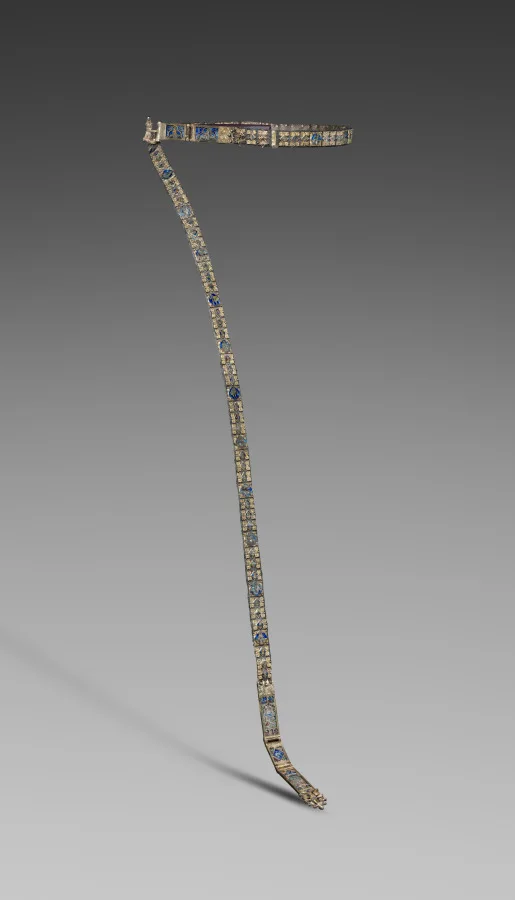
Belt for a Lady's Dress
Details
- Author / creator
- Italy, Siena(?)
- Object type
- Jewellery
- Date or period
- c. 1375–1400
- Dimensions summary
- Overall: 236.5 × 2.9 × 0.6 cm
- Maker or workshop
- Italy, Siena(?)
- Period / style
- Gothic
- Place of origin
- Italy
- Acquisition method
- Donation
- Credit line
- Gift of the Pemberton family, 1930
- Image rights
- Public domain (CC0)
About this object
Because of its extraordinary richness, this belt (also known as a girdle) was both an ornament for the body and an object of great personal luxury. Almost eight feet in length, belts like this were at the height of fashion for both men and women. After being passed around the waist and through the buckle, one end of the belt would fall to the hem of the garment. The belt's many colorful enamel plaques are worked in translucent enamel over decoration engraved into the silver beneath (an enameler's technique known as basse-taille). Within the plaques and cast into the buckle are scenes of courtly love, musicians, and fantastic animals. A large number of translucent enamels were made for secular objects during the late Middle Ages for use on jewelry, cups, garment clasps, and similar objects. This belt is a rare survival among these now scarce objects.
Materials and technique
Basse-taille enamel and gilding on silver, silver thread, gilt-silver buckle, cast and chased