Textiles & Costume
Mantle
Textile
Details
- Author / creator
- Peru, South Coast, Paracas (Cavernas) style
- Object type
- Textile
- Date or period
- c. 300 BCE–200 CE
- Dimensions summary
- Overall: 154.9 × 292.1 cm; Mounted: 162.6 × 299.7 cm
- Place of origin
- Peru
- Acquisition method
- Donation
- Credit line
- Gift of Sir Frederick Ashcombe, 1946
- Fibres
- Camelid fibre
- Structure
- Embroidery
About this object
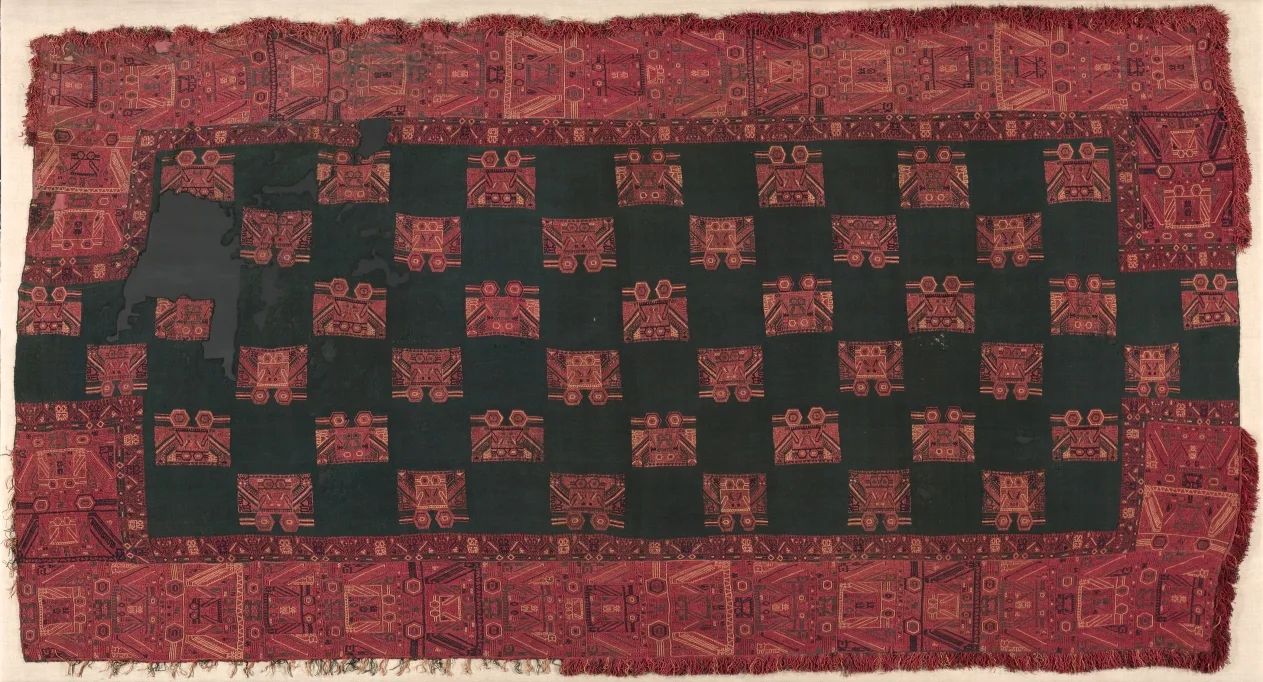
Buried in shaft-tombs, or rectangular sunken chambers, the Paracas dead were wrapped in layers of cloth and accompanied by pottery, food, and other offerings. The dry environment of the Paracas Peninsula helped preserve many of these textiles, including richly ornamented garments buried with important individuals. This mantle, probably worn like a cloak, relates closely to the tunic (the museum 1946.227) and long headband (the museum 1946.228) due to their shared imagery. Its double-headed bird motifs— embroidered in vivid red, blue, yellow, and green yarns—likely had symbolic significance, although the specific meaning remains unknown.
Materials and technique
Camelid fiber: plain weave with embroidery